
Last year, the international NGO and aid sector took a major hit. The aid world shook. Questions surfaced everywhere about whether aid should be reduced, paused, or stopped altogether; about whether foreign aid has actually been sustaining civil society work in Africa or distorting it. That debate is complex. I cannot summarise it in a blog post, and I do not intend to try.
What has stayed with me, though, is something related and (in my opinion) less voiced.
Even though research shows that foreign aid has never sufficiently funded grassroots care work, advocacy, and community labour, there was a widespread perception that “most of the work” was being sustained by external funding. The fact that we believed this even when it is not true reveals something dangerous: we have lost sight of who is actually responsible for holding up the work that keeps communities alive.
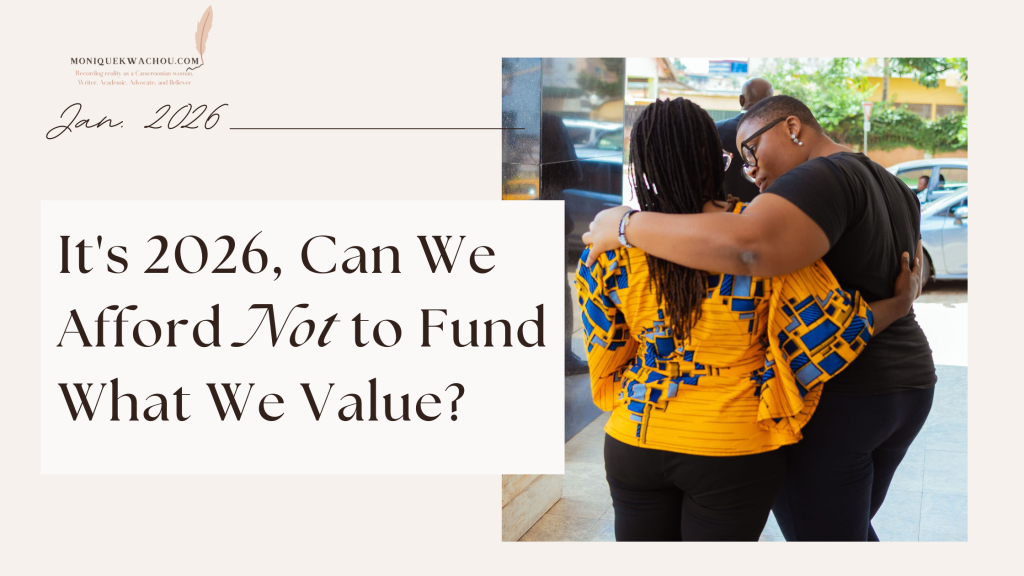
This year, I want us to consider putting our money where our mouth and heart are. I want us to consider taking stock of who holds the purse strings behind the spaces and things we value. By us, I mean my Cameroonians first, and my fellow Africans on the continent next. You see, it’s more obvious in advanced capitalist societies in the West. Everything has already been commodified to a T. They know to wield their purchasing power to resist and protect. But in our context, I think we haven’t grasped it yet. But we must.
As the world becomes more aggressively capitalist, as wealth concentrates, as everything is monetised, as care, art, and conviction are increasingly turned into “content”, it is imperative that we actively protect and materially support people doing essential work, or they will burn out, fail, or be forced to compromise their values. We must recognise that even (perhaps especially) work that is of the soul, any work that pushes against the system, in fact, any work that does not immediately translate into material value, but holds spiritual, humanitarian, artistic, or community value, still needs to be financially sustained.
Because the person doing that work is still living inside a capitalist system. They still have bills to pay. They still have children to send to school. They still need to survive.
I learned this lesson firsthand.
For the first ten years of its existence, I ran Better Breed Cameroon mostly by myself and 70% out of pocket. I do not discount the fact that people believed in me and sowed into it, but most of that time, leadership and execution rested largely on my shoulders, alongside my doing a PhD, paid work, and life itself.
As should be expected, I eventually burned out, and when I stepped back to reflect upon taking a gap year, I came away with one major lesson: even “heart work” (as I called my labour of love at Better Breed Cameroon) needs to be paid and appreciated.
Knowing it is your calling is not enough. Passion is not enough. Love is not enough.
This is how good work collapses, or worse, mutates and morphs into what is unrecognisable. Not always because the people behind it get greedy (though that happens), but mostly because exhaustion makes compromise inevitable and survival pressures the doers of sacred work to sell themselves.
The fact is that it is this need for financial sustenance that led to the NGOization of the resistance, with nonprofits operating very much like for-profits despite supposedly having different ends. So though we are judging the civil society space and watching it shrink in Cameroon (and frankly, everywhere), I want us to note that it is not limited to just NGO/resistance work. All hard-to-commodify work, be it care work or a piece of art or hobbies, etc., all those are at risk. We are increasingly pushed to turn our hobbies into profit, our care and convictions into profitable service. I cannot count the number of times someone has said to me, “Oh, you could turn this into a money-making venture.”
And each time, I wonder: “How? It won’t be the same!”
Because what drives this work is the fact that I care. So the moment I start chasing views, followers, and revenue, what happens to the heart of the thing? Do I still care about the work, or would I start caring more about performance, reach, and return? Is there a middle ground? I am sure there is. I’m still musing. Perhaps someone who has found that middle can share 🙂
But till then, my conviction at this time is that: we, individuals, must take up our causes and buy into our own sacred spaces. We have to fund what we want to keep sacred.
The danger of what can happen when we don’t is everywhere.
Everything now wants a subscription. Every platform needs ads. Someone, somewhere, has to be paid. Or worse, someone somewhere wants to make us dependent on them and control us (cough neocolonialism cough). We can say, “This should be free.” But free often just means someone else is paying the cost, with their time, their health, their burnout.
I am a Christian. I donate to the Bible app I use because I want it to remain ad-free. I cannot imagine opening my Bible and seeing an advertisement. I give to Wikipedia because I still believe in shared, accessible knowledge, even if it’s publicly co-created. I am not saying this to show off. These are visible platforms with donation links. The harder question is about local work, the invisible labour that keeps communities functioning, or the members of these communities doing what no one else can take time off to do. Yet the most important work we must fund and ensure remains protected is our sacred local work.
When work is funded locally (when communities buy into it materially, not just rhetorically) something important happens: accountability becomes possible. It is much easier to hold organisations, initiatives, and leaders accountable when the people funding them understand the local realities, the constraints, and the needs. Foreign funders, no matter how well-intentioned, are distant. They do not live with the everyday contradictions. They do not always grasp what is urgent versus what is merely legible in a proposal. Local buy-in creates proximity, and proximity creates responsibility.
For ten years, Better Breed Cameroon did not solicit funding. Each time I wanted to give up, I would think of those who believed in my vision enough to fund a prize for the Sama Randy Youth Write Contest or to volunteer. The people I knew and had to communicate with every day were my accountability partners and motivation. This is why it survived.

And so I try to do the same for the initiatives I appreciate, like Stand Up for Cameroon, because I understand that someone is paying the cost for that work, getting imprisoned each time they protest for the rights of average citizens like me. No valuable work is unpaid; someone is sacrificing. So it is imperative that we sow into it before it becomes something else, before the sacred is forced to sell itself.
This also applies to knowledge work. Cameroon is deeply under-researched.
Our data gaps are not accidental. What you do not know, you cannot get angry about. What you cannot name, you cannot change.
~ Monique Kwachou, 2026
There is a political advocate, Benjamin Ngongang, researching and creating content in a way I deeply appreciate. His informative videos reach me across platforms. His work is careful, concise, and made accessible to the public. That kind of labour looks simple, but it only seems so because of how much labour has gone in to make it so. It matters, and it needs protection.
This year, I’m hoping more of us encourage such people. Support them financially if you can. But even if not, send a message that says, “I see you and appreciate your work.”
We live in a moment where “making it” within capitalism has become the goal. It doesn’t matter if it is ethical or not. Because we have so celebrated whoever makes it on the Forbes list, the fact that they tend to end up in prison afterwards is less hyped. We don’t care about the how and the why when faced with the how much and how many views.
And then we wonder why an AI musician can outperform a real one.
That should leave us all pondering. We have to be intentional. We have to materially protect the people doing that work. And we have to do so locally, where accountability is real, and relationships matter.
If we want art for art’s sake, truth for accountability and authenticity’s sake, care for community’s sake, we have to be intentional. We have to protect those who create and work for what we value.
Fund them. Encourage them. Name their value.
If someone cleans your street without being asked, recognise them. If someone does community work quietly, appreciate them.
This is how we keep the sacred from being hollowed out. May this be our pledge for 2026.