

It is the month of love.
Everywhere around us, love is being marketed loudly, particularly romantic love. Grand gestures. Gifts. Performative affection. All to prove that you love and are loved.
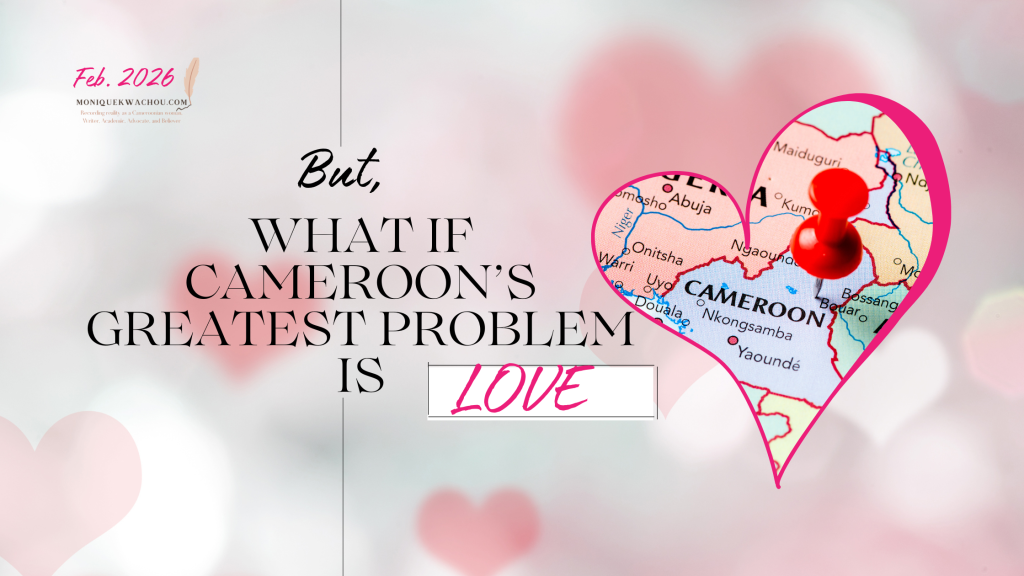
As in past years, my musings for this February tie to this month’s theme, but rather than reflecting on a kind of love, I’m thinking of our (Cameroonians’) collective lack thereof. Because the more I sit with it, the more I feel that one of Cameroon’s deepest problems is not just the corruption, nepotism, tribalism, poor governance, or development failure we so readily name, but a lack of love.
A lack of self-love, a lack of love for this country, and a lack of love for each other.
I know this sounds soft. Romantic, even. Idealistic…
There’s a scene from Harry Potter that I’ve never forgotten. In the final book, when Harry tells Voldemort that he will never understand why he cannot defeat him, Voldemort scoffs: “Is it love again? Dumbledore’s favourite solution?” And Harry basically replies in the affirmative; it is love.
It seems like such a minor exchange in a children’s book, but it captures something profound: the tendency to dismiss love as weak or naive when confronted with what we perceive as “real” power or “real” problems.
So I know someone reading my claim here will scoff and say, “No, Monique, we have real problems. Economic problems. Structural problems. Political problems.”
And yes, I agree, we do.
But even if those problems did not originate in a lack of love, they are certainly being sustained by it.
Let me explain using an analogy I’ve used with friends in the past:
If I come into your home and I see something beautiful, a display cabinet, for instance and how you’ve set up your kitchen, or a welcoming chair you’ve put into your living room, I will admire it. I will ask where you got it from. And chances are, I’ll leave your place planning to get something similar for myself.
Why? Because I appreciated what you had, and I want my own space to look good too. That is self-love.
Now think about this. We have people in power who travel constantly. They see how things work elsewhere. They experience efficiency, dignity, and beauty through various airports they frequent on official missions and luxurious vacations. Their kids reside in countries with roads that make sense and where they can take walks without seeing a pile of dirt on the road.
And then they come back home. They see the dysfunction here. The chaos. The lack of care.
And yet they do nothing. The majority of our leaders and our ‘1%’. are okay with their wealthy friends coming to their country to see it unchanged, poorly groomed, without care.
If they truly loved themselves — truly — they would want their own things to look good.
This is not even about morality. It is basic selfishness. A natural byproduct of a healthy ego.
If you love yourself, you want the best for yourself. You want comfort. You want quality. You want to show off.
And yet, even in our selfishness, we fail.
We have people who steal billions, but cannot enjoy themselves properly at home because the system they refuse to fix still affects them.
Do you see how a lack of self-love is at the root of our mess? And it’s not just the leaders who lack it; we as a people collectively need more self-love.
Yes, we are underdeveloped largely as a result of historical injustices and oppressive global systems sustaining inequality. But the question remains: do we love ourselves enough to want better? Do we love ourselves enough to create standards and respect them? Do we love each other? Look at any African country that is prospering right now (note: I’m not saying they’re perfect); economically, they’re doing fairly well and progressing compared to Cameroon.
If you go to these countries, you see a common factor: national pride.
Literally everything in Kenya has the flag on it. Literally everything in South Africa screams “Mzansi”. Every other street is named after Nelson Mandela. Nigerians will criticise their country from one end to the next, but they are prouder than proud of who they are. Senegalese, the same thing.
But we Cameroonians? We are proud in competition, and we have very little to compete with, so it’s usually shallow. You’ll hear other countries banter on Twitter, saying they’re so much better than us in terms of development, and a Cameroonian will retort, “But we have Eto’o!” (as if he’s not part of the problematic system).
I can’t tell you how often I’ve been in the company of mixed nationalities and heard a Cameroonian put down Cameroon and other Cameroonians. A friend recounts being in a meeting where Cameroon was being considered to host the hub for an international programme, and a fellow Cameroonian dismissed the idea.
It is crazy how little we love our own. How desperate we are to just leave the place. Nobody wants to really fix it. We have given up on it.
It’s that lack of self-love that is sustaining the system. Yes, the system is already bad, but what is keeping it bad? What is making it worse? It’s our lack of self-love.
Before coming to the conclusion that the lack of self-love is at the root of our problems, I thought ours was a problem of elitism. But the more I examined our elitism, the more I realised it was a symptom, not the disease. The elitism we practice and aspire to arises from the fact that we don’t love ourselves or each other enough to believe we all deserve dignity, and because our love, when we would have it, is conditional, reserved for exceptionalism.
We don’t care that the system is bad. We just want to benefit from the system ourselves. We want to be the exception to the rule. We want to get into institutions like ENAM (École nationale d’administration et de magistrature) rather than tear down the system ENAM is a part of, a system that produces a crop of administrators complicit in our collective oppression, who see leadership as a privilege and superiority rather than service. We want to become one of those privileged officials or for our own person to be one of those superior officials so that we can benefit.
And therein lies the problem: our collective craving to be exempt from rather than to fix the brokenness of the system.
This is easily observed in our obsession with VIP treatment, titles, and our reverence for the ‘elite’.
Nearly every bus service is VIP. Going for regular means being treated as substandard, choosing ‘VIP’ means we get what should be standard service. A fully functioning bus is marketed as ‘VIP’, while one with AC issues, rusted seats, etc., is marketed as ‘regular’. Every single minister wants to be called His/Her Excellency, though it is well known that, by diplomatic protocol, that is not their title.
And make that mistake and call a Professor “Doctor”? You will die. Our elitism is a real problem.
If we truly loved ourselves, we would demand basic dignity for everyone — not special treatment for a few.
We would want decent roads, not reserved for the capitals and neighbourhoods where the elites reside, but because we are human and we pay taxes. We would want functioning hospitals not only in our bourgeois capitals but nationwide, because we never know where our loved ones or we may have an emergency. To love ourselves and each other is to recognise that a functioning system benefits us all, and this failing one affects us all, no matter what party you belong to, what socioeconomic class you are in, or what linguistic and ethnic group you belong to.
But our love for ourselves and each other is very conditional. We seem to think some people deserve to be treated more humanely than others. We think it’s fair that we get substandard treatment when we are poor, uneducated or just average.
So rather than asking why national forums are inaccessible, we ask what we need to do to get invited.
We don’t care who is excluded so much as we care about our proximity to who is included.
The average Cameroonian prayer is: “Lord, do for my family and me,” a testament to the dearth of our collective love.

And because we focus on gaining access to good treatment rather than destroying the system that discriminates, when someone from a marginalised group finally reaches a position where they could change something, they don’t. They adapt. They blend. They protect the very structure they once criticised.
They have become ‘exceptional’, so all is well. See the likes of Francis Ngannou, Kylian Mbappe and co. who, now being exceptional given socioeconomic status, fame and most importantly other nationalities, have little negative to say about the systems that forced them to leave the country.
So yes, we have compounded systemic problems, many of which are legacies of imperialism and neocolonialism, etc. Yes, we have governance issues we can name as the ‘problem with Cameroon’. But upon considering them all, I am left with this somewhat simplistic belief: if we had more self-love, there would have been more people standing up to the systems rather than begging to benefit from them. There would have been more attempts to change the country than to escape it,
For there to be change, we must first love ourselves, each other, and this country enough to think we deserve better, not just hope to be granted it as a favour.
We cannot fix this country without love. I hope by now you see that I am not being soft or sentimental here; the love I am thinking of is strong and intentional. A love that insists on our dignity as a people, a love that has the least of us aware of what they deserve (see how Americans always harp on about their rights). I want us to desire better for ourselves and for our own. The Cameroonian dream should NOT be to leave the country or become one of the chosen few. I wish for us a love that says: if it is not good enough for all of us, it is not good enough at all. Only then can we truly and sustainably fix this nation.
Thats the love I’m musing about this February.
Perhaps this is utopic, but I invite you to muse along with me.
Let me know your thoughts in the comments.


1 Comment
Aaah Monique. You said m’y mind so well. If there was love even in the familles, we would have a better Cameroon. I don’t know how to put it, sometimes I feel disgusted.