

End-of-year reflections aren’t new. We’ve always done them, some of us in journals, some of us at “crossover nights on New Year’s Eve, most of us around an impending birthday… when the year is slipping away, or you’re becoming older, you suddenly feel an itch to reflect. I think it’s a sign of us being intelligent beings. “I think, therefore I am”, or whatever Descartes said.
But these days? Reflection has become… loud.
In the last few years, with the advent of things like Spotify Wrapped and other recap features, our end-of-year reflective practices have morphed from introspective moments into a public sport. Our apps now tally up what we listened to, where we spent money, what we read, and who we followed, then turn it into colourful graphics for us to share. It’s everywhere. It’s visible. And as a result, it’s competitive.
You might have heard the Instagram reel sound used to capture a full year in pictures: January, February, March, etc. (I have wanted to use that reel sound so badly!) Or you may have seen people recapping all the places they went to over the course of the year and wished that it were you. The truth is, we all know comparison is a thief of joy, but it’s hard not to compare when you have this onslaught of everyone else’s highlights in your face each time you open social media, and you’re all too familiar with your own failings.
So what do we do? How do we check out of this competition none of us signed up for?
I haven’t come to tell you to ‘just don’t compare’. Rather, I’m here to share a lesson the Holy Spirit taught me in 2023 when I was feeling particularly disappointed in myself for not having achieved as much as a colleague in the Cameroonian CSO space. They had been racking in the awards, and I was about to take a gap year because I was burned out, but I had achieved way less than they had.
Then the Holy Spirit convicted me: Were those awards my goals? Were they my “Key Performance Indicators” (KPIs as we say in corporate, lol)? If so, what does that say of me, and if not, why do I think my failure is defined by not having had them? That reflection, prompted by the Holy Spirit, led me to have two conversations with friends Juisi and Valerie Viban. I must say, I didn’t feel like a ‘success’ after that; the reflection forced me to clearly define what being successful in youth work meant to me. And even by my own self-defined KPIs, I knew I could have done better. BUT now, I wasn’t feeling unsuccessful for the wrong reasons.
That experience has come to mind several times since then. It keeps envy and discontent at bay often, because when you know what you really want, when you have interrogated your why, and defined for yourself what happiness or success is. What is meaningful to you and not because you think you should have it or because it is expected of you… When you have those personalised definitions, contextualised for your phase of life? It’s all easier to take in.
In an older blog post I wrote entitled “Want to have a successful year? How are you defining success?”, I reflect on one of my favourite poems (or is it merely a quote?) that I recently learned is wrongly attributed to Ralph Waldo Emerson but is really the work of Bessie Anderson Stanley. See the image below of it:
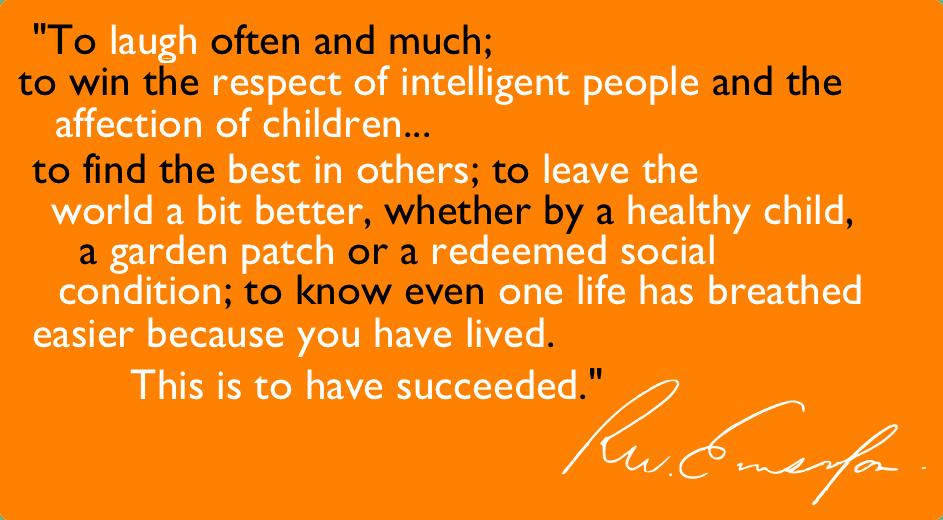
I love that piece dearly for the simple way it highlights what truly matters. Notice it doesn’t say achieve everything on your five-year plan. It doesn’t say win prizes or go viral. Because if you were to die next week, wouldn’t it matter more that you contributed something meaningful to society, made those who look up to you (children) smile, and created a handful of happy moments?
It doesn’t even say be impressive.
It just says: contribute, be affirmed by people of substance (not everyone), bring joy where you can.
That is enough.
Often, when we look back and write off a year as bad, or when setting goals for the next year. I feel the difficulty itself is realising that we don’t even know what we mean when we say we want a “successful” year.
And truth be told, most of us don’t stop to ask that question.
We inherit definitions from society, from childhood, from social media… and we start running with them.
But it is necessary, imperative, to define success for yourself and to interrogate why you’ve defined it that way. If you don’t, you end up chasing a finish line that isn’t even yours. Or chasing a goal post that keeps moving every time you near it.
So, as you look at recaps and evaluate how this year went, think of the poem “What Is Success” and remember that the little things matter:
Did you laugh? (Even if it was at TikToks and memes.) Did you bring a bit of joy to someone, anyone at all, a child, a friend, a stranger? Then they have lived easier because you were alive in 2025. Did you appreciate nature, beauty, or a moment of peace? Did you leave even one corner of the world better than you found it?
According to that poem, many of us have succeeded without knowing it because these are not things that get awards. Nobody gives you a fellowship for surviving a hard year. There is no prize for emotional labour or resilience. No app will tally how many burdens you quietly carried or how many small kindnesses you offered. And yet, that is success.
Maybe you didn’t win anything this year, but you made someone feel safe.
Maybe you didn’t hit your goals, but you grew.
Maybe the year stretched you, but you didn’t break your principles…
Maybe you laughed more than last year.
Maybe you left somebody better.
If that isn’t success, then what is? At least by a definition that feels human.
So as you reflect this year, let it be honest. Let it be personal. Let it be yours.
Not a performance. Not a comparison.
Just a conversation between who you were, who you are now, and who you’re becoming. You might find that you succeeded in ways your recap will never show.
And as you plan for next year, join me in creating individual, realistic, context (person)-specific KPIs. Nothing that pits us against anyone else. But rather only what is truly about us living fully.